
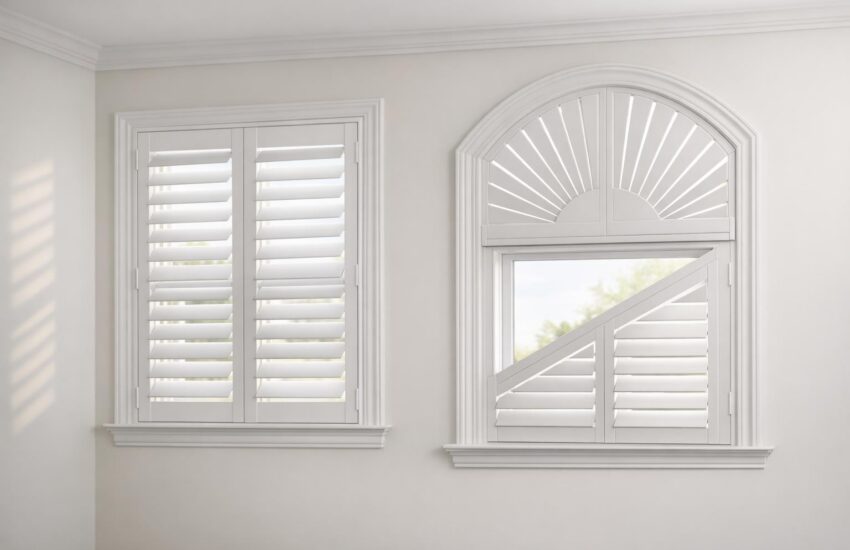
Timeless louvers or a made-to-fit statement? Match your shutters to your windows—and your life.
Plantation shutters are the classic choice: clean lines, adjustable louvers, and a polished finish that works in everything from historic Denver homes to new builds along the Front Range. Specialty shutters, on the other hand, are the “problem-solvers” and “show-stoppers”—crafted for arches, angles, bays, oversized glass, and uniquely shaped windows where standard layouts fall short. This custom shutter guide breaks down the differences, the design impact, and the practical considerations that matter most for Colorado homes and commercial spaces.
Woven Window has been fabricating and installing custom window treatments across Colorado since 1999. If you’re weighing plantation shutters vs. specialty shutters, the best results come from combining design intent (what you want the room to feel like) with real-world needs (glare, privacy, temperature swings, and day-to-day usability).
Plantation shutters: the go-to classic
Plantation shutters are interior shutters with wide louvers (slats) set inside a frame. The look is architectural and clean—finished enough to feel built-in, but flexible enough to manage changing light throughout the day.
Best for: standard rectangular windows, consistent elevation symmetry, primary bedrooms, living rooms, street-facing windows, and any space where you want a tailored look without heavy fabric.
Why homeowners and designers like them:
• Adjustable louvers for privacy + daylight (especially helpful on bright Colorado afternoons).
• A crisp finish that pairs well with modern, transitional, and traditional interiors.
• Easy upkeep compared with many soft treatments—dusting is usually the main routine.
Specialty shutters: custom solutions for non-standard windows
Specialty shutters are designed for windows that don’t fit a standard rectangle or need a specific function—think arches, circles, octagons, gables, angled tops, and bay windows. They can be fixed or operable depending on the window shape and your goals.
Best for: arched windows in entryways, gable windows in vaulted spaces, sunrooms, stairwells, distinctive architectural elevations, and any room where you want to highlight (not hide) an unusual window.
Why specialty shutters matter: Colorado homes often include dramatic architectural glass—large openings, angled rooflines, and bright exposures. Specialty shutters let you keep the architecture while still gaining control over glare and privacy.
Plantation vs. specialty shutters: side-by-side comparison
| Feature | Plantation Shutters | Specialty Shutters |
|---|---|---|
| Window shape | Rectangles, common sizes | Arches, angles, circles, bays, custom geometry |
| Light control | Excellent with adjustable louvers | Varies by design (fixed shapes may prioritize view/architecture) |
| Privacy | High (tilt louvers, close panels) | High when operable; fixed shapes provide privacy but less adjustability |
| Design impact | Clean, symmetrical, “built-in” feel | Highlights architecture; tailored to unique openings |
| Best rooms | Bedrooms, living rooms, street-facing windows | Entries, stairwells, vaulted great rooms, statement windows |
| Installation complexity | Straightforward with accurate measuring | Higher; specialty frames and templates require precision |
Quick “Did you know?” shutter facts
Dusting is usually enough. Many shutter care guides recommend regular light dusting and using only a slightly damp cloth (then drying right away) when needed—especially for wood finishes.
Energy performance depends on the full window system. “R-value” describes resistance to heat flow; higher is more insulating. Shutters can help, but results vary with the window’s glass type, air leakage, and how tightly the shutter fits.
Special shapes don’t have to be a compromise. Specialty shutters can preserve an arched window’s character while still offering privacy and glare control—often with a mix of fixed and operable sections.
How to choose the right shutters: a practical step-by-step
1) Start with your window’s shape and trim depth
If the opening is a standard rectangle and you have enough depth for a frame, plantation shutters are often the most straightforward. If the window is arched, angled, circular, or part of a bay, specialty shutters typically deliver a cleaner fit and better visual balance.
2) Decide what you want to control: glare, privacy, or view
For TV glare, home offices, and bedrooms, prioritize easy adjustability. For statement windows where the view is the main feature, specialty solutions can be designed to “frame” the glass while still softening harsh light.
3) Match material to room conditions
Kitchens, baths, mudrooms, and high-traffic commercial areas often do best with moisture-resistant, durable materials. Bedrooms and formal spaces may prioritize a specific painted or stained finish to coordinate with millwork and flooring.
4) Think about how the shutter panels will open
Do you need frequent access to a crank window? Is there furniture near the sill? Panel configuration (and where the hinges land) affects everyday usability more than most people expect.
5) Plan the look across the whole home
One of the most designer-friendly approaches is mixing styles where it makes sense: plantation shutters on standard windows, and specialty shutters for feature windows—using consistent finishes and louver proportions so the home still feels cohesive.
Colorado angle: why shutters are a smart match for Front Range light
Colorado’s bright days and strong sun exposure can make light control feel non-negotiable—especially in west-facing rooms and spaces with large panes. Shutters are popular here because they let you fine-tune the balance between privacy and daylight without closing off the room. For many homes, pairing shutters with complementary soft treatments (like drapery panels) can add softness and additional insulation for winter comfort—while shutters handle daily light management.
If you’re designing for a mountain view, specialty shutters can be engineered to preserve the architecture of a dramatic window shape while still reducing harsh glare during peak sun hours.
Helpful internal resources from Woven Window
Want a full overview of options beyond shutters? Visit Window Treatment Services to compare styles and learn what works best room-by-room.
Considering a layered look with soft treatments? Explore Custom Drapery for insulation, blackout potential, and a finished designer feel.
If you’re coordinating finishes across a remodel, you may also like Best Drapery & Curtain Fabrics.
For a seamless finish, professional installation matters. Learn what to expect on Window Treatment Installations.
Curious about the people behind the craft? Read About Woven Window.
Already leaning toward shutters? Start here: Custom Shutters.
Ready for a custom shutter plan for your Colorado windows?
Whether you’re outfitting a single statement window or standardizing shutters throughout a home, a professional measurement and design consult keeps the project smooth—from panel layout to finish selection.
FAQ: Plantation shutters, specialty shutters, and custom planning
Are plantation shutters a good fit for modern homes?
Yes. Wide louvers and clean frames read architectural and minimal, especially in bright whites or soft neutrals. They can look just as at-home in a contemporary loft as they do in a traditional home.
What counts as “specialty shutters”?
Any shutter made for a non-standard window shape (arches, circles, angles, gables, bays), or a shutter layout engineered around special constraints—like unusual trim, deep sills, or window hardware that needs clearance.
Do shutters help with energy efficiency?
They can contribute by adding an insulating layer and reducing drafts near glass, but performance depends on the full window system (glass type, window condition, and fit). If energy savings are a top priority, ask for options designed to improve sealing and light gaps, and consider pairing shutters with other strategies (like upgraded glazing or layered treatments).
How do you clean plantation shutters?
Regular dusting is the main routine. For spots, use a slightly damp cloth and then dry promptly—avoid soaking the louvers, and skip harsh cleaners that can dull finishes.
Can I mix plantation shutters and specialty shutters in the same home?
Absolutely. Many well-designed homes use plantation shutters on standard windows and specialty shutters for architectural focal points—keeping finishes and louver style consistent so everything feels intentional.
Glossary (quick definitions)
Louvers
The horizontal slats that tilt open/closed to control light and privacy.
Panels
The framed shutter sections that swing open (like a door) to access the window.
Frame depth
How much space you have inside the window opening to mount a shutter frame cleanly and securely.
R-value
A measure of resistance to heat flow; higher R-values indicate better insulating performance.
