
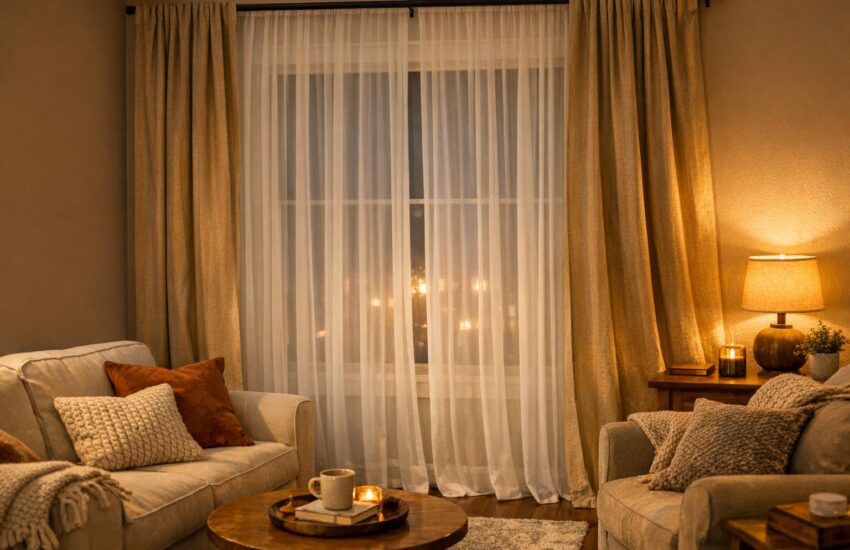
Ambient lighting, privacy, and warmth—without giving up daylight
The easiest way to make a room feel calm at night is to control how light behaves at the window. When you layer sheers and curtains, you’re not just adding fabric—you’re shaping glare, softening contrast, and creating a “lamps-on” glow that makes a space feel finished. For Colorado homes (where sunny days and chilly evenings can happen in the same 24 hours), this approach also supports comfort by adding an insulating layer and flexible light control.
Why layering works (and why it feels so cozy)
Layering gives you two “modes” at the same window: a daytime layer that keeps rooms bright and livable, and an evening layer that adds privacy, warmth, and a more intimate mood. Done well, it also improves the look of your windows by adding depth—similar to how a rug plus drapery plus art makes a room feel intentionally designed.
Layer 1: Sheers (the light diffuser)
Sheers soften direct sun, reduce harsh contrast, and provide daytime privacy in many situations (especially when it’s brighter outside than inside). They’re ideal for living rooms, kitchens, offices, and any space where you want sunlight—just not the glare.
Layer 2: Curtains or drapes (the comfort + privacy layer)
Your outer layer handles evening privacy, light blocking, and that “wrapped in warmth” feeling. This is also the layer that can help reduce drafts when properly sized and installed close to the window—an important comfort win during Colorado’s colder months.
Design context: matching the room’s “light personality”
When homeowners and designers talk about ambient lighting, they’re usually describing how comfortable a room feels when overhead lights are off. Windows are a major part of that. Layering works best when you decide what you want the room to feel like at three times of day:
Morning: bright, energizing, minimal glare
Afternoon: balanced light for screens and tasks
Evening: cozy, private, layered light that flatters the room
Quick “Did you know?” facts
Did you know: In winter, energy guidance often recommends opening window coverings on sunny mornings to let solar heat in, then closing them at night to reduce heat loss.
Did you know: Solar screen/shade fabrics use an openness factor (a percentage) to describe how tightly woven the material is—lower openness typically means more glare/heat/UV protection and less visibility.
Did you know: Cellular (honeycomb) shades are widely recognized for strong thermal performance because their structure creates insulating air pockets—useful for comfort during colder weather.
A simple comparison: sheers alone vs. layered
How to layer sheers and curtains (step-by-step)
1) Start with the “evening goal”
Decide what cozy means in your space: more glow (light-filtering curtain), more privacy (lined curtain), or near-darkness (blackout lining). Your outer layer should be chosen for nighttime performance first—because that’s where most disappointments happen.
2) Pick sheers that “read” as clean, not busy
If your outer curtain has pattern or texture, keep sheers simpler (soft white, warm ivory, or a gentle natural). If your curtains are solid, you can add a more textured sheer (subtle slub, linen-look, or a quiet pattern) to build depth without harsh contrast.
3) Use two layers of hardware (for smoother function)
For the best operation, plan for a double rod or a track + rod combination: sheers closest to the window, curtains on the room side. This keeps the sheer layer available all day while the curtain layer can stay open, stacked neatly off the glass.
4) Get the proportions right (this is where “custom” pays off)
Cozy rooms usually have curtain panels that feel generous rather than skimpy. Two common finishing moves: mount higher to visually lift the ceiling, and extend width beyond the window so glass stays clear when panels are open. The result is better light, a larger-looking window, and a more tailored appearance.
5) Don’t forget “stack-back” and floor clearance
Layering adds volume. You’ll want enough space for both layers to stack neatly without blocking the glass. And if you have radiant floor heating, floor vents, pets, or robot vacuums, hem height matters more than most people expect.
Where Roman shades, solar shades, and blinds fit into a layered plan
Layering doesn’t have to mean “two curtain panels only.” Many of the most functional designs in cozy home decor combine a tailored shade at the glass with curtains at the room side.
Roman shades + side panels
Roman shades bring a soft, upholstered look at the window—great for dining rooms, bedrooms, and refined living spaces. Pair them with stationary drapery panels to add height and a finished frame.
Related: Roman Shades
Solar shades + sheers or curtains
For strong Colorado sun on south- and west-facing windows, solar shades can cut glare while keeping a view. Add sheers when you want extra softness, or add curtains for evening privacy and a warmer look.
Related: Solar Shades
Blinds + curtains (classic, practical)
If you need precise tilt control (street-facing rooms, bathrooms with frosted glass, or home offices), blinds can handle the “fine tuning” while curtains provide softness and a designer finish.
Related: Premium Blinds | Custom Drapery
Colorado angle: cozy evenings with high-altitude sunshine
Colorado homes often deal with bright winter sun, big temperature swings, and strong light that can feel intense in open-plan spaces. Layered window treatments help you respond hour-by-hour:
Sunny winter mornings: Keep sheers open (or lightly drawn) to diffuse glare while still letting warming sunlight in.
Late afternoons: Close the sheer layer more fully on bright exposures to soften contrast and make indoor lighting feel balanced.
Evenings: Draw the outer curtains/drapes to reduce “black mirror” window reflections, improve privacy, and make the room feel warmer and calmer.
If you’re planning a full refresh, a professional measurement and install is where layered projects become effortless—hardware placement, fullness, and hem height are what make the final result feel tailored instead of “store-bought.”
Learn more about expert fitting: Window Treatment Installations
Want a layered look that feels cozy—day and night?
Woven Window designs and fabricates custom solutions that balance sheers, curtains, and complementary shades so your home stays bright in the day and comfortable at night—finished with professional installation across Colorado.
Schedule a Design Consultation
Prefer to learn about the team first? About Woven Window
FAQ: Layering sheers and curtains
Do sheers provide privacy at night?
Not reliably. When it’s darker outside and lights are on inside, sheers typically offer minimal privacy. That’s where the outer curtain/drape layer becomes essential.
Should the sheer go in front of or behind the curtain?
Behind, closer to the window. This keeps the sheer available for daytime softness while allowing the outer curtains to be the primary style statement.
What’s the best color for sheers?
Most rooms look best with a light neutral that matches your trim or wall undertone (soft white, warm ivory, or gentle flax). This keeps windows bright and avoids a “gray cast” in daytime light.
Do layered curtains help with drafts?
They can. Heavier fabrics, proper sizing (width and length), and close-to-window installation can reduce the feeling of cold air near glass—especially in older homes or rooms with large windows.
How do I choose fabric that looks “cozy,” not heavy?
Look for texture and lining choices that suit the room: linen blends, brushed cottons, and softly textured weaves read warm. A quality lining can add body and improve drape without making the face fabric feel bulky.
Fabric guidance: Best Drapery and Curtain Fabrics
