
• Home
  • Commercial Elegance: Custom Window Treatments for Colorado Businesses

Commercial Elegance: Custom Window Treatments for Colorado Businesses

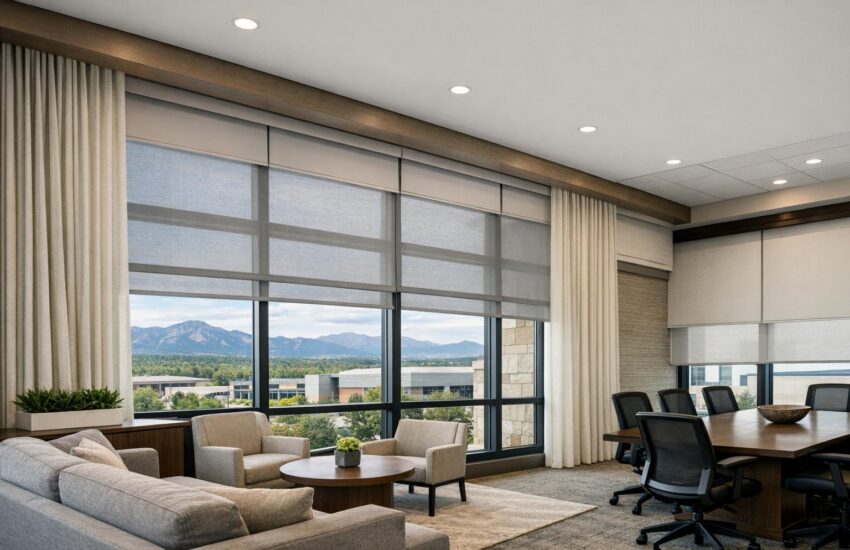
Modern Colorado commercial office interior showcasing custom window treatments with solar shades, roller shades, and drapery, emphasizing daylight management and professional design.
by:wovenwindow February 1, 2026 0 Comments

Tailored shades, drapes, and blinds that work as hard as your space does

Colorado commercial interiors have a unique balancing act: intense sun, big temperature swings, and clients who expect spaces to feel polished—without sacrificing comfort or functionality. The right window treatments help you manage glare on screens, protect furnishings from UV exposure, improve privacy, and support energy efficiency, all while elevating the look of your brand. At Woven Window, we design and fabricate custom solutions for offices, hospitality, healthcare, multifamily, and retail across Colorado—built for daily use and finished with design-level detail.

What “commercial-grade” window treatments really mean

In commercial spaces, window treatments aren’t just décor. They’re a performance layer that has to stand up to frequent operation, cleaning protocols, safety requirements, and sunlight that can be more punishing than most people realize—especially at Colorado’s elevation.


A well-designed commercial specification typically considers:

 
• Glare control for workstations, lobbies, and conference rooms
• Daylight management to keep spaces bright without harsh hotspots
• Privacy for street-facing glass, exam rooms, or ground-floor offices
• Durability (hardware, fabrics, and lift systems made for high cycles)
• Cleanability and safety (cordless options, wipeable surfaces, antimicrobial considerations where appropriate)
• Energy strategy (reducing solar heat gain in summer and improving comfort in winter)
 

When these factors are handled early—during design or build-out—window treatments stop being an afterthought and become part of a cohesive interior plan.

Choosing the right treatment by business type (and why it matters)

Different industries experience light and privacy differently. A boutique fitness studio might want soft daylight with full evening privacy. A medical practice may need cleanable, hygienic solutions with controlled views. An office may prioritize screen glare control and consistent brightness throughout the day.

 
Space Type Top Priorities Best-Fit Options
Offices & conference rooms Glare control, consistent daylight, clean lines Solar shades, roller shades, motorized blinds
Hospitality (hotels & restaurants) Ambience, guest privacy, layering for day/night Custom drapes, decorative side panels, blackout rollers behind sheers
Healthcare Privacy, cleanability, light comfort Roller shades, privacy sheers, wipeable fabrics, cordless systems
Retail & storefronts UV protection, merchandising visibility, heat control Solar shades, zebra/banded shades, layered solutions
Multifamily & property management Consistency, durability, turnaround speed, resident privacy Roller shades, faux wood blinds, vertical options for sliders
 

If your project includes large glass areas, west-facing exposures, or a high volume of daily occupants, it’s often worth designing a zoned approach—different fabrics or opacity levels by elevation, orientation, or room type—so the building feels intentional, not one-size-fits-all.

Performance details that elevate day-to-day comfort

Great commercial window treatments don’t just look refined on install day—they keep spaces comfortable on a bright Tuesday afternoon, when the sun is pouring through the glass and everyone is trying to focus.

 
Solar shades for glare + view. Fabric openness (often described as 1%–10%) helps balance visibility with glare reduction. Lower openness typically means stronger glare control and more privacy.
Blackout layers for hospitality and privacy zones. A layered approach—such as a light-filtering shade for daytime paired with blackout for night—offers flexibility without compromising aesthetics.
Motorization for consistency and safety. Motorized shades and blinds can help standardize how a space looks throughout the day (especially in multi-window elevations) and reduce wear from repeated manual operation.
Drapery for softness, acoustics, and luxury. In lobbies, restaurants, and boutique offices, custom drapes bring warmth and polish while helping soften echo in hard-surface spaces.
 

When a project has sustainability or occupant-wellness goals, glare control and controllable daylighting also support broader design standards used in commercial buildings, where window shading strategies are a recognized part of glare management planning.

How to specify commercial window treatments (step-by-step)

Whether you’re a business owner, property manager, or interior designer, a clean process saves time and prevents costly re-orders—especially on larger elevations and multi-phase installations.
 

1) Map the sun and the use of each room

Note which windows are south/west facing, where screens sit, and when rooms are occupied. A conference room with afternoon meetings needs a different approach than a north-facing breakroom.
 

2) Choose your “performance goal” first

Decide what matters most per zone: glare control, view preservation, privacy, insulation/comfort, or dramatic aesthetics. Then pick the product category that supports that goal.
 

3) Select fabrics and finishes that match your brand

This is where commercial elegance happens. We’ll coordinate texture, color, and hardware finishes so window treatments reinforce your interior palette rather than feeling “added later.”
 

4) Confirm operations and controls

For busy environments, motorization can reduce daily friction (and protect treatments from over-handling). For hospitality and client-facing spaces, consistent alignment across windows is a subtle detail that reads as high-end.
 

5) Measure professionally and plan installation timing

Commercial projects often involve ladder access, after-hours scheduling, tenant coordination, or phased construction. Professional measurement and installation protects your investment and keeps the finished look crisp and consistent.

Where custom drapes still win in commercial design

While roller and solar shades are a workhorse for modern projects, custom drapes are still one of the most effective ways to add softness and intent—especially in hospitality, luxury offices, and spaces where acoustics matter.


Custom drapery can be engineered for commercial needs with:

 
• Lining options (privacy, room-darkening, blackout)
• Hardware built for scale (long spans, corner windows, and tall ceilings)
• Decorative layering that makes a lobby or dining room feel finished
• Fabric selection that balances texture, drape, and maintenance needs
 

If you want a cleaner contemporary profile but still crave softness, pairing tailored drapery with minimalist shades can deliver both structure and warmth.


Local angle: what Colorado businesses should plan for

Colorado’s light is a design asset—and a practical challenge. Higher elevation can mean more intense sun and faster fading for textiles if windows are left unmanaged. Add big seasonal swings (bright winter sun, hot summer afternoons), and window treatments become one of the simplest ways to improve everyday comfort without a major remodel.


For many Colorado projects, we recommend:

 
• West-facing strategy: prioritize glare control and heat management for afternoon exposure
• UV-conscious layering: protect finishes, artwork, flooring, and upholstery in sunny lobbies and storefronts
• Privacy planning: street-level glass often needs daytime privacy without making the space feel closed
• Consistent aesthetics across elevations: keep street-facing windows aligned for a clean, branded exterior view
 

Woven Window has served Colorado since 1999, with a woman-owned team that understands how to translate performance requirements into a finished look that feels intentional—whether you’re outfitting one office suite or multiple properties.


Ready to plan commercial window treatments that look refined and perform better?

If you’re sourcing commercial window treatments, need business blinds in Colorado, or want custom drapes that hold up to real-world traffic, we’ll help you select the right solution for your space, timeline, and budget—then measure and install with a clean, professional finish.
 

FAQ: Commercial window treatments in Colorado

What are the best commercial window treatments for office glare?

Solar shades and roller shades are often the most effective first step, especially for screen-heavy spaces. The best choice depends on window orientation, desired view, and how much privacy you need during the day.
 

Are motorized shades worth it for businesses?

For many commercial projects, yes—especially when you have large banks of windows, tall ceilings, or consistent brand presentation matters. Motorization also reduces daily wear and helps keep operation safe and straightforward for staff.
 

What’s the difference between residential and commercial drapery?

Commercial drapery often requires more durable hardware, longer spans, and fabric choices tailored for maintenance and longevity. It’s also common to layer solutions (sheer + blackout) so the space can shift from day to night service.
 

How do I choose opacity for solar shades?

Opacity and openness affect glare control, privacy, and view. Lower openness tends to reduce glare more and increase daytime privacy. We typically recommend selecting by room function (conference rooms vs. open office vs. lobby) and by sun exposure.
 

Do you handle design, fabrication, and installation?

Yes. Woven Window provides expert design consultation, custom fabrication, and professional installation across Colorado to ensure the finished result fits correctly and operates smoothly.

Glossary (helpful terms when planning business blinds and shades)

Openness factor: A percentage that describes how “open” a solar shade fabric is. Lower openness typically reduces glare more and increases privacy; higher openness preserves view more.
Blackout: A fabric or lining designed to block nearly all light, commonly used in hospitality, privacy zones, or spaces where light control is critical.
Light-filtering: A fabric that softens daylight while still allowing a bright, comfortable glow—often used in offices, lobbies, and retail.
Layering: Combining two treatments (for example, a solar roller shade with decorative drapery) to achieve better control over privacy, glare, and aesthetics.
Motorization: An automated operating system for shades or blinds, controlled by remote, wall switch, app, or integrated building/smart controls (depending on project needs).
 

Categories:

Call us now!