
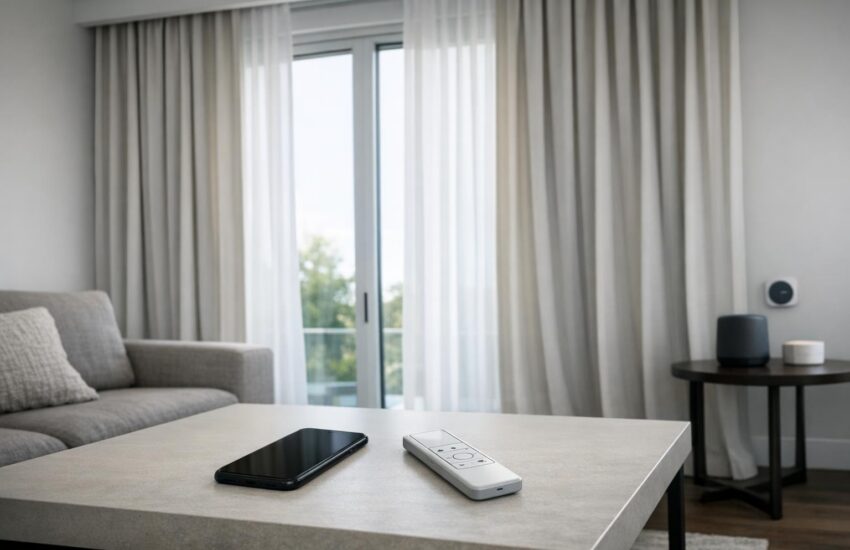
Make your windows work on your schedule—quietly, safely, and beautifully
Motorized drapery has moved far beyond “nice-to-have.” Today’s motorized drapery, smart home shades, and voice-activated curtains can be integrated into the same routines that manage lighting, thermostats, and security—so your home feels comfortable without constant manual adjustments. For Colorado homeowners and interior designers, that convenience pairs especially well with our intense sun, wide temperature swings, and high-altitude glare.
At Woven Window (Denver-based, woman-owned, serving Colorado since 1999), we help clients choose the right combination of fabrics, hardware, and motors—then coordinate design, fabrication, and professional installation so everything operates smoothly and looks intentional.
What “smart motorized drapery” really means
Motorized drapery usually refers to a powered drapery track (or rod system) that opens and closes drapery panels. “Smart” integration adds one or more control options:
1) Local control
Wall switch, handheld remote, or a pull-start feature (depending on system).
2) App control
Open/close from your phone—helpful when you’re traveling or juggling busy mornings.
3) Voice control
“Voice-activated curtains” via common platforms when the motor/bridge supports it.
4) Automations
Schedules, sunrise/sunset actions, temperature-based comfort scenes, and “away mode.”
Integration options: Matter, hubs, and “bridges” (without the tech headache)
When we plan a smart window system, we start with one question: What do you want it to do every day? Then we match the motor/control approach to your home’s ecosystem.
A quick, practical way to think about compatibility
Matter-enabled devices are designed for broad smart-home compatibility (often via a hub/controller in your home). For many homeowners, this reduces “will it work with my phone/voice assistant?” surprises—especially for smart home shades and newer motors.
Bridged systems use a gateway to translate between the motor’s radio protocol (common in the window-covering world) and your smart home platform. This can be an excellent, stable choice for whole-home shading and drapery—especially when you want grouped rooms, quiet operation, and reliable schedules.
Step-by-step: how to plan motorized drapery that feels seamless
Step 1: Decide what you want to automate
Common routines we build for Colorado homes: morning open (gentle daylight), midday glare control, evening privacy close, and “movie mode” that coordinates drapery with lighting.
Step 2: Pick the right drapery style for the track
Not all headers stack the same. Ripplefold, pinch pleat, and tailored pleats each create different “return” and stack-back requirements. We’ll plan the fullness so panels glide cleanly and park where you expect.
Step 3: Confirm power + access (hardwired vs. battery)
Drapery tracks are often hardwired in new builds and renovations; battery solutions can be ideal when you want minimal disruption. Either way, we plan for serviceability—so you’re not removing finished trim to reach a connection point.
Step 4: Choose “control layers” for everyday life
The best experience combines at least two layers: a physical control (remote or keypad) plus automation/app control. Voice is great—but guests and babysitters still appreciate a simple button.
Step 5: Schedule + fine-tune after installation
Many systems allow precise positioning, speed control, and favorites. We recommend living with your scenes for a week, then adjusting timing and “park” positions to match real habits.
Comparison table: which smart option fits your project?
| Approach | Best for | What you’ll love | Considerations |
|---|---|---|---|
| Motorized drapery + remote | Simplicity, guest rooms, quick upgrades | Clean look, easy daily use | No voice/schedules unless upgraded later |
| Motorized drapery + bridge/hub | Whole-home scenes, multi-room grouping | Reliable routines, integration with lighting/thermostats | Needs thoughtful network + hub placement |
| Matter-capable window motors | Platform flexibility and newer smart ecosystems | Streamlined compatibility across major platforms | Confirm exact device support before purchase |
Designer note: if your goal is a layered look (e.g., solar shades for daytime glare + drapery for softness and nighttime privacy), we’ll coordinate how the treatments stack, clear each other, and share consistent control logic.
Did you know? Quick facts that make motorization worth it
Safer daily living: going cordless reduces entanglement risks and keeps windows visually clean.
Better fabric longevity: consistent open/close behavior can reduce edge fraying and uneven sun exposure over time.
Comfort you notice: scheduled shading is one of the simplest ways to manage glare and heat gain in bright rooms.
Where motorized drapery shines (rooms + use cases)
Great rooms with tall glass
Large openings can be heavy and awkward to operate. A motorized track makes daily movement easy and protects premium fabrics.
Primary bedrooms
Pairing drapery with a shade underneath can deliver the “hotel calm” feel: soft daytime light, then privacy and darkness at night.
Commercial and hospitality spaces
Durable operation, consistent presentation, and centralized control can support daily workflows in offices, restaurants, and hotels.
Colorado angle: sunlight, altitude, and temperature swings
Colorado homes often face strong, direct sun and dramatic seasonal shifts—especially in rooms with big west- or south-facing windows. Smart schedules can help manage glare during peak sun hours and support comfort when temperatures fluctuate. If you’re designing for the Front Range, automated shading strategies can also protect art, flooring, and textiles by reducing prolonged UV exposure in the brightest parts of the day.
Want to explore materials that perform well in sunny rooms? Our fabric expertise is a major part of creating window treatments that last.
Ready to plan motorized drapery that integrates cleanly with your smart home?
Share your goals (voice control, schedules, blackout needs, fabric preferences, and rooms). We’ll help you select the right system, coordinate the details, and install for smooth, quiet performance.
FAQ: Motorized Drapery + Smart Home Shades
Will motorized drapery work if my Wi‑Fi goes down?
Most well-designed systems still allow local control (remote and/or wall control). Smart features like app access outside the home may pause until the network is restored, but you’re not “locked out” of operating your drapes.
Can I add voice control to my existing curtains?
Sometimes, yes—depending on how your curtains are hung and whether a retrofit solution can move them smoothly. For many homes, a dedicated motorized track provides the cleanest look and the most reliable daily operation.
What’s the difference between motorized drapery and motorized shades?
Drapery moves side-to-side on a track. Shades move up/down (or tilt, depending on type). Many Colorado homes benefit from layering: a shade for sun control + drapery for softness, acoustics, and nighttime privacy.
Is motorization noisy?
Quality motors and properly installed tracks are designed for smooth, quiet movement. Noise typically comes from misalignment, incorrect carrier spacing, or fabric interference—details professional installation helps prevent.
What do you need from me to quote a motorized drapery project?
Window sizes (or a measurement appointment), photos of the space, ceiling height, and your goals (privacy, blackout, glare control, automation). If you already have a smart home platform, tell us which one so we can plan compatibility from the start.
Glossary (helpful terms, simplified)
Motorized drapery track
A powered track that moves drapery panels open and closed.
Bridge / Gateway
A device that connects window motors to your smart home system so you can use apps, scenes, and voice assistants.
Scene (or Routine)
A preset action—like “Good Morning”—that adjusts multiple devices at once (drapes, shades, lighting, and more).
Stack-back
How much space the drapery panels occupy when fully open. It affects how much glass remains visible.
Layered window treatments
Combining two treatments (like solar shades + drapery) for better control of glare, privacy, and style.
